Conferences
The program gathers for “noon conference” daily from 12:30 P.M. until 1:30 P.M. Monday through Thursday. Topics covered include general internal medicine, subspecialty conferences, resident journal club, resident conferences, clinicopathologic conference, continuous quality improvement, medical jeopardy, morning report, and others.
Clinicopathologic Conference
Clinicopathologic conference is led by a third year resident. A case is chosen in which pathology assisted in reaching a definitive diagnosis. The case is presented, differential discussed, and pathology reviewed.
Continuous Quality Improvement
The purpose of Continuous Quality Improvement is to provide a forum to discuss medical errors, morbidity, mortality, and error prevention. This conference is designed to elucidate problems with healthcare delivery both in terms of systems error and human error.
Journal Club
The Journal Club is held throughout the year. This conference, which consists of a resident-led discussion of an original article, is designed to educate each resident on the intricacies of research methodology and its applicability to the medical literature.
Medical Jeopardy
This activity provides an enjoyable, fun, and fast paced way to review pertinent teaching cases, medical knowledge, and the occasional general trivia category.
Morning Report
The Chief Resident leads morning report in which PGY-1 residents present cases to the group followed by a discussion focusing on the differential diagnosis, diagnostic strategy, and management. This forum provides a comfortable learning environment for medical students, residents, and attending physicians alike.
Resident Conferences
Residents are required to present a lecture on a topic of their choosing each year.
Rotations
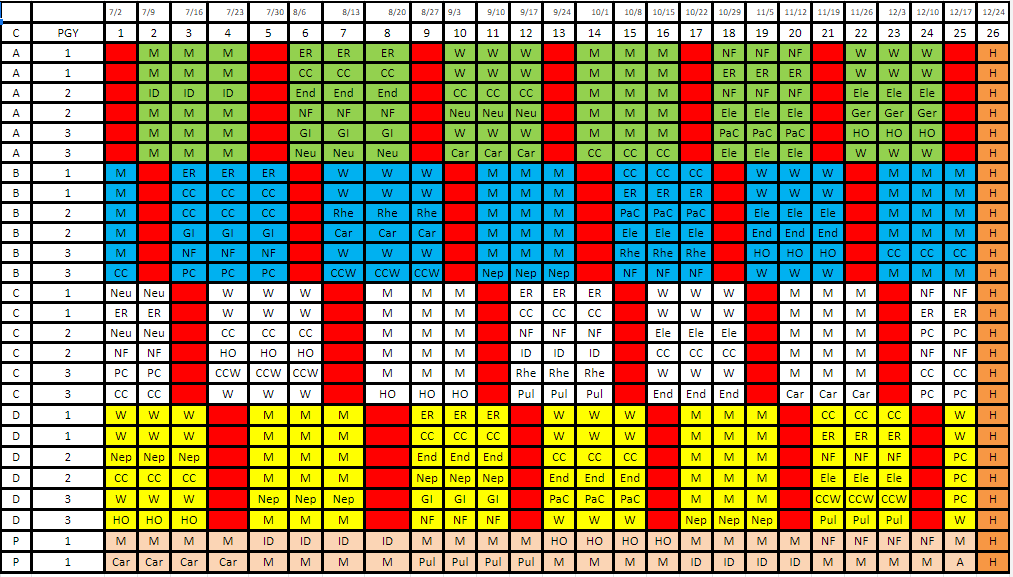
UT-Nashville Internal Medicine residents receive their training in a variety of clinical and educational settings. Beginning in 2015, the program adopted a 3+1 ambulatory block schedule. Typical schedules can be found below.
Year One
Addiction Medicine
Ambulatory Medicine
Critical Care
Emergency Medicine
Geriatrics
Infectious Diseases
Inpatient General Medicine
Night Float
Palliative Care
Vacation
Year Two
Ambulatory Medicine
Critical Care
Endocrinology
Gastroenterology
Inpatient General Medicine
Nephrology
Neurology
Night Float
Rheumatology
Vacation
Year Three
Ambulatory Medicine
Cardiology
Critical Care
Hematology Oncology
Infectious Diseases
Inpatient General Medicine
Night Float
Primary Care
Pulmonary Medicine
Vacation
Inpatient Service
The general medical inpatient service is designed to enable residents to evaluate and manage patients with a broad range of medical problems in both the intensive and non-intensive care settings. Residents rotate on inpatient service teams at both hospital training sites.
Night Float
The night float rotation is designed to provide each resident with the experience of admitting patients during night time hours, as well as managing in-hospital needs and emergencies of his or her colleagues’ patients during the night. Effective transition of care is a point of emphasis on the night float rotation. PGY-1 residents do one month of night float under the supervision of a senior resident.
Ambulatory Medicine
The continuity clinic experience incorporates a diverse group of patients that each resident follows throughout residency. The 3+1 ambulatory block schedule is structured so that residents spend 13, one-week blocks per year in clinic. During each ambulatory week, a resident attends 4-6 half day sessions seeing his or her patients. The rest of the week is structured into reverse classroom sessions led by residents and attended by faculty, which focus on various topics in ambulatory medicine and quality improvement.
Subspecialty
Subspecialty rotations are interspersed between inpatient medicine months and are designed to further each resident’s clinical competency as applied to each subspecialty. Subspecialty rotations required include: Cardiology, Critical Care, Infectious Diseases, Emergency Medicine, Endocrinology, Hematology, Oncology, Nephrology, Neurology, Geriatrics, Gastroenterology, Pulmonary, Rheumatology, Dermatology, and Ambulatory Medicine.